

Get Better Answers with Fusion Analytics
Turn open-ended conversations into explainable, interactive insight maps. Explore themes, compare segments, and trace every finding back to the source.
Overview
Fusion Analytics ingests conversations from multiple sources and converts open-ended language into topics, standardized semantic units, and traceable evidence. It then layers quality, sentiment, segments, and scoring so teams can explore patterns, compare groups, and defend conclusions with verbatim source context.

Visualization-First
Move from lists to landscapes.
Dimensional
Layer sentiment, engagement, quality, and segments.
Explainable
Every chart opens to the words behind it.
Two Analysis Modes
Fusion Analytics supports (1) respondent-centric analysis for single-participant survey/interview conversations that standardizes and scores responses for comparable distributions, and (2) knowledge-graph analysis for multi-participant dialogue that extracts conversational points with traceable evidence and applies attributes across speakers, topics, and relationships.


Mode 1 — Single-participant conversations
Best for surveys and interviews with a question-response exchange pattern, where one respondent maps to one conversation. Fusion treats the respondent and conversation as directly coupled.
Mode 2 — Multi-participant conversations
Best for open-form dialogue with multiple speakers and variable formats. Fusion uses a flexible methodology that produces graph objects and attributes across multiple node types.
Single Participant Analysis
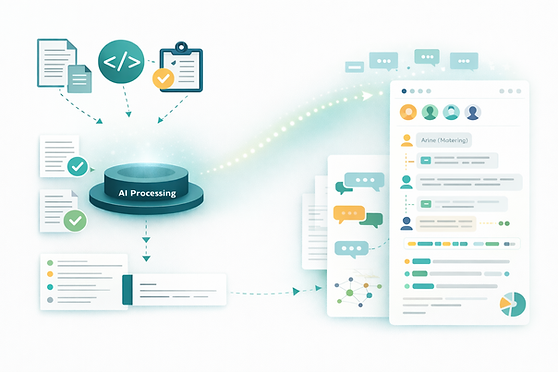
Fusion ingests single-participant conversations from Curious AI, external uploads, and integrated systems via API, using parsing templates to normalize formats into a consistent interviewer-interviewee and question-response structure.


Multi-Participant Analysis
Fusion ingests multi-participant dialogue from meetings, chats, workshops, and facilitated sessions. It identifies speakers, turn structure, and context so free-form conversation becomes analyzable without forcing a rigid survey format.


Drill Down
From signal to sentence in one click. Open any node to see the exact verbatim words behind a pattern and the metadata that supports it.

-
Raw Responses — timestamped, speaker‑labeled, and evaluation scores.
-
Response Primitives — standardized semantic units to retain nuance and fidelity.
-
Sentiment & Tone — emotional polarity, intensity, class, attitude, and other dimensions that reveal feelings.
-
Engagement Measurements — how the individual's engagement changes during the survey or interview.
-
Quality Metrics — amplify stronger signals and dampen low-confidence data.

Correlations
Examine relationships across responses and topics, identify underlying components, and detect patterns and outliers.


Reporting and Sharing
Configure Fusion to your organization.
-
Text Reports — define or import map structures that fit your needs.
-
Scoring — define custom parameters for scoring qualitative or numerical data.
-
Sentiment — Measure sentiment toward specific topics with polarity, intensity, and class labels.
-
Extraction — Extract specific entities from conversations.
-
Presentation — Show insights directly from Fusion using configurable report formatting and organization.
-
View-only Link — Share interactive results securely with view-only authenticated access links.


